
Capping A, 10 % Acetic Anhydride in THF (Tetrahydrofuran / Acetic Anhydride, V / V = 90 : 10) PurOligo
PurOligo
Synonym: Capping A
Linear Formula:
Tetrahydrofuran: C4H8O, Acetic anhydride: C4H6O3
Molecular Weight: Tetrahydrofuran: 72.11 g/mol, Acetic anhydride: 102.09 g/mol
Properties
| Water Solubility | Soluble |
| Assay Purity | THF: > 99.9 %, Acetic Anhydride: > 99.5 % |
| B pt. | 64 °C |
| Form | Liquid |
Safety Information
| Hazard Statement(s) | H225-H302+H332-H315-H318-H335-H351-EUH019-EUH019 |
| Precautionary Statement | P280-P301+P312-P304+P340-P312-P305+P351+P338-P308+P313 |
| GHS Pictogram |
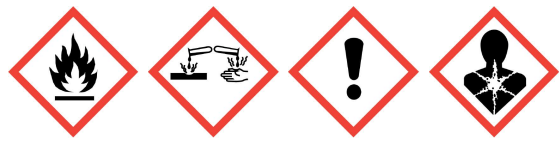
|
| Signal word | Danger |
| HS Code | NA |
| Flash point | -20 °C |
| Storage Temp. | Room Temperature |
| Storage Class | 3 - Flammable liquids |
| UN Number | 2924 |
Description
Other Notes
For each synthesis cycle up to 1 to 2 % of free 5-hydroxy groups remain after the phosphoramidite coupling step has been completed. By running a subsequent Capping step using an anhydride these free hydroxyl groups are converted to acetates and are hindered from further chain elongation and formation of long oligonucleotides with incorrect sequences. For optimal acetylation a solution of acetic anhydride in Tetrahydrofuran or acetonitrile (Capping A) will be mixed in situ during reaction with a catalytic acting solution of N-methylimidazole (Capping B). Additives such as pyridine and lutidine function as mild bases to enhance the efficiency of the capping reaction.
Application
Capping A consisting of 10% acetic anhydride in THF is used during automated solid-phase oligonucleotide synthesis to cap unreacted hydroxyl groups on the growing DNA or RNA chain.
Purpose
Its purpose is to prevent unreacted nucleosides from participating in subsequent synthesis cycles thereby reducing the formation of truncated or deletion sequences and improving the purity of the final oligonucleotide product.
General Description
Capping A is a solution containing 10% acetic anhydride and 90% tetrahydrofuran (THF) by volume (VV 9010). Acetic anhydride reacts with unreacted 5-hydroxyl groups and acetylates them effectively blocking these sites from further phosphoramidite coupling. THF serves as the organic solvent and provides a suitable medium for the capping reaction.
Documents
| SDS | |
| COA | |
| Specification | |
| Bulk quote order form | |
| Sample COA |
