
Formic acid For mass spectrometry, PurReagent, >= 98.0%
PurReagent
Properties
| Vapour pressure | 44.8 mmHg (20°C) |
| Water Solubility | Soluble |
| Autoignition temp. | 1004°F |
| Explosion limit | 12-38 % (v/v), 57 % |
| Assay Purity | >= 98% |
| Refractive index | n20/D 1.370 (lit.) |
| B pt. | 101°C/1013 hPa |
| M pt. | 8.2-8.4°C (lit.) |
| Density | 1.22 g/mL at 25°C (lit.) |
| Form | Liquid |
Safety Information
| Hazard Statement(s) | H226 - H302 - H314 - H331 |
| Precautionary Statement | P210 - P280 - P301 + P312 - P303 + P361 + P353 - P304 + P340 + P310 - P305 + P351 + P338 |
| GHS Pictogram |
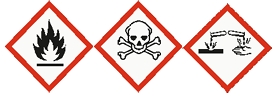
|
| Signal word | Danger |
| HS Code | 29151100 |
| Storage Temp. | Room Temperature |
| Storage Class | 3 - Flammable liquids |
| UN Number | 1779 |
Description
Application
Added to mobile phases in LCMS and LCMS-MS analyses. Widely used in proteomics for peptide and protein analysis. Applied in pharmaceutical analysis to detect drugs and metabolites. Used in environmental and food testing for trace compound detection.
Purpose
Its main role is to enhance ionization efficiency especially in positive ion mode. It donates protons helping analyte molecules form positively charged ions which improves detection sensitivity and signal stability.
General Description
Formic acid (HCOOH) is a small volatile organic acid commonly used as an additive in liquid chromatographymass spectrometry. It is compatible with MS because it evaporates easily and does not leave significant residues.
Documents
| SDS | |
| COA | |
| Specification | |
| Bulk quote order form | |
| Sample COA |
