
Trifluoroacetic Acid for spectroscopy
Others
Properties
| Vapour pressure | 97.5 mmHg ( 20 °C) |
| Water Solubility | 10,000 g/l |
| Assay Purity | >=99.8% |
| Refractive index | n20/D 1.3 (lit.) |
| B pt. | 72.4 °C (lit.) |
| M pt. | -15.4°C(lit.) |
| Density | 1.489 g/mL at 20°C (lit.) |
| Form | Liquid |
Safety Information
| Hazard Statement(s) | H314,H332,H412 |
| Precautionary Statement | P261 - P273 - P280 - P303 + P361 + P353 - P304 + P340 + P310 - P305 + P351 + P338 |
| GHS Pictogram |
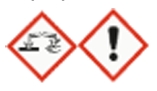
|
| Signal word | Danger |
| HS Code | 29159099 |
| Storage Temp. | Room Temperature |
| Storage Class | 8A - Combustible corrosive hazardous materials |
| UN Number | 2699 |
Description
Application
In spectroscopy trifluoroacetic acid is mainly used as a solvent or additive to improve sample solubility and stability. In techniques like NMR and HPLC-related detection it helps in protonating compounds sharpening peaks and improving resolution. Its simple structure also minimizes interference in spectra making it useful for accurate analysis of organic molecules.
Purpose
Its primary purpose is to provide a highly acidic medium for reactions. It is used to remove protecting groups in peptide synthesis act as a catalyst in organic reactions and improve the solubility of compounds. It also helps in analytical techniques by
General Description
Trifluoroacetic acid is known for its high acidity stability and ability to dissolve a wide range of organic compounds. It is also relatively non-oxidizing and can act as both a solvent and a reagent in chemical reactions. Due to its volatility it can be easily removed from reaction mixtures by evaporation.
Documents
| SDS | |
| COA | |
| Specification | |
| Bulk quote order form | |
| Sample COA |